


LinkedIn Algorithm 2026: How It Ranks Posts and Why Your Reach Dropped

Updated October 2026.
How does the LinkedIn algorithm work in 2026? Since March 2026, one LLM-powered model reads every post together with the author's professional profile and the reader's professional history, then predicts whether that specific person will find it worth their time. Posts that hold attention, earn saves and spark expert comments get distributed. Posts nobody finishes stop early, no matter whether a person or an AI wrote them.
Key facts
- What LinkedIn rewards: dwell time, saves and substantive comments from professionals. Document posts lead with about 6.6 % engagement because swiping holds attention.
- What stopped working: engagement pods (detected with about 97 % accuracy), hashtag stacking and early-hour posting tricks.
- Company pages: organic posts make up only about 2 % of what people see in their feed, and personal profiles earn around five times more engagement.
- AI content is not penalized. Generic content is: posts without a specific professional insight fail every signal the algorithm now measures.
- Scheduling does not hurt reach. The algorithm evaluates the post, not the tool that published it.
LinkedIn's algorithm cannot detect AI-written content. What it detects is whether anyone cared enough to finish reading. That is why so many agency clients see falling reach in 2026, and why switching formats or posting times does not fix it.
Reach dropped hardest around March 2026, when LinkedIn replaced its entire feed ranking system. According to Richard van der Blom's Algorithm Insights 2025 Report, the most widely cited independent benchmark of LinkedIn performance:
- Views fell roughly 50% year-over-year
- Engagement dropped 25%
- Follower growth declined 59% in the period leading up to and following this change
Understanding what replaced the old system, and what it now rewards, explains the numbers your clients are asking about.
{{form-component}}
What Changed in LinkedIn's Feed Algorithm in 2026
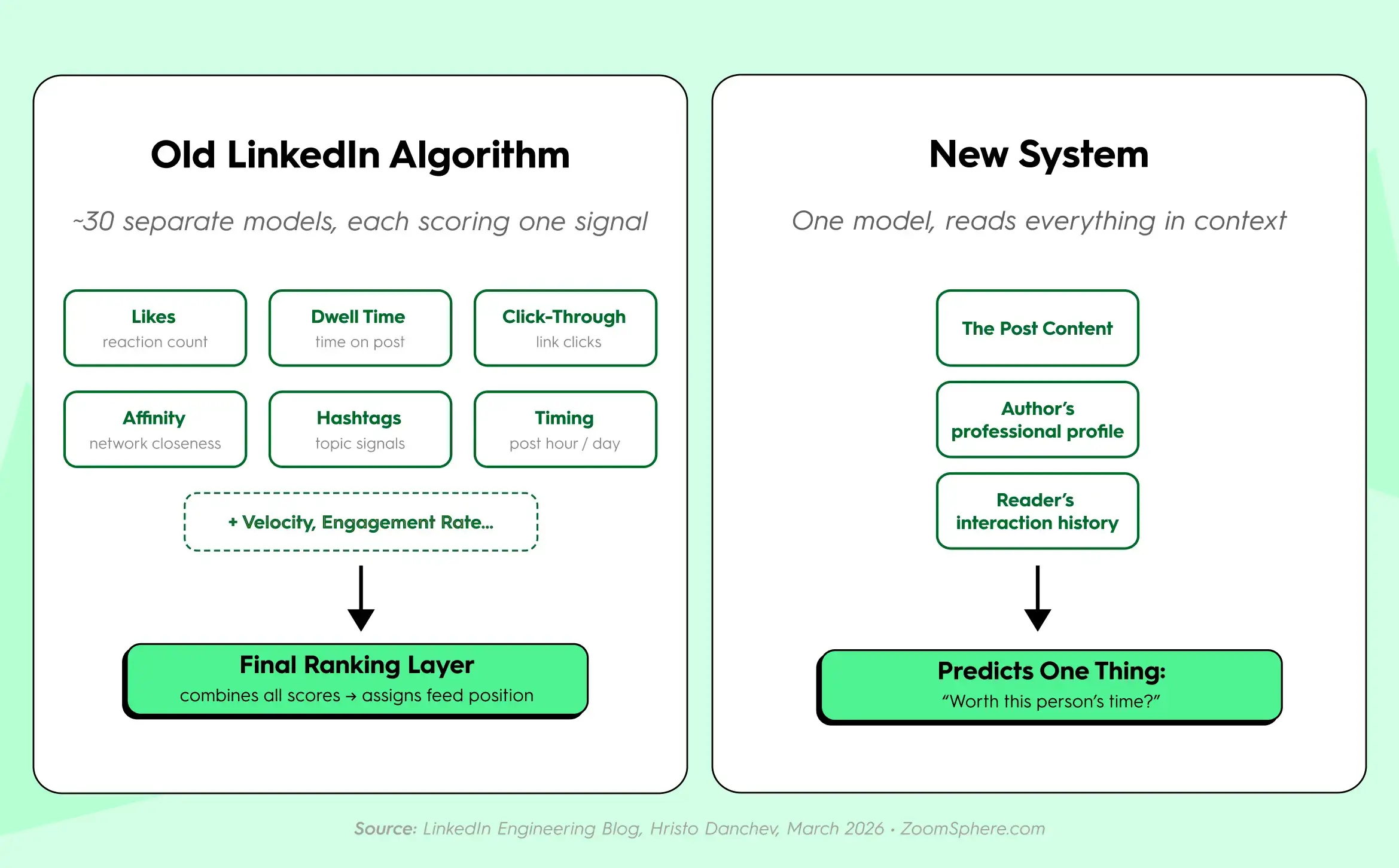
On March 12, 2026, LinkedIn's engineering lead Hristo Danchev published an update to the LinkedIn Engineering Blog announcing the next generation of the platform's feed: a unified retrieval and ranking system powered by large language model embeddings, replacing the previous fragmented architecture of separate specialized models. Search Engine Land's March 2026 coverage confirmed the shift to LLM-powered ranking and retrieval. This was not a minor algorithm tweak. It was a rebuild of how the feed decides what to show.
LinkedIn's previous system was a chain of specialized models, each responsible for one signal.
- One counted likes
- One measured dwell time
- One tracked click-through rates
- One evaluated network proximity
A final layer combined all of these into a ranking score. The system was gameable: stack enough signals in the right order and reach would follow. This is why tactics like engagement pods, early-hour posting windows, and hashtag optimization could reliably move numbers. The system was counting behaviors, not evaluating meaning.
The new system replaced that chain with a unified LLM-powered model. Instead of adding up separate scores, it reads a post together with the author's professional profile and the potential reader's professional history, then predicts one outcome: would this specific person find this worth their time?
The old system rewarded posting behavior. The new system evaluates whether a post contains something specific, professionally credible, and worth finishing. Most agency workflows were built to produce content that performed well on the old system. They are not producing content that performs on the new one.
What LinkedIn Now Rewards: Understanding the Depth Score
The cluster of behavioral signals that now determines distribution on LinkedIn is what practitioners call the depth score — a term used in third-party analyses, not an official LinkedIn metric. It describes what the algorithm is now measuring: sustained professional attention rather than passive reactions. LinkedIn has been signaling this direction since at least February 2024, when Senior Director of Engineering Tim Jurka outlined the platform's move away from engagement-bait content — posts prompting "Comment YES if you agree," recycled thought-leadership, content designed to game distribution rather than serve readers — toward expertise-first distribution. The March 2026 feed update enforced these principles at model level.
The clearest evidence of this shift is in format performance. Dataslayer's April 2026 analysis shows document posts averaging 6.60% engagement, the highest of any content type on the platform, precisely because swiping through slides forces sustained attention and extends time-on-post. A post someone reads for thirty seconds outperforms one that collects fifty quick likes. This is the depth score in practice: the algorithm rewards posts that hold people long enough to mean something.
Saves are the highest-intent signal the depth score can measure. A save requires conscious effort and signals future value. LinkedIn has not published exact signal weights, but this is consistent with how modern LLM-based recommendation systems distinguish genuine interest from passive scrolling — weighting interactions by the amount of intent they reveal rather than their raw count.
Comment quality registers differently than comment quantity. Because the current system reads language semantically, a thread where three professionals add distinct perspectives from their own work is a stronger signal than ten "great post" replies. On the subject of artificial engagement: Whitehat's April 2026 B2B Algorithm Guide cites research placing LinkedIn's coordinated pod detection accuracy at 97%. Engagement pods do not produce genuine distribution gains under the current system and represent a risk rather than a lever.
Why LinkedIn Changed the Rules: The Microsoft Context
LinkedIn is part of Microsoft. Microsoft is building Copilot. Copilot needs high-quality professional knowledge, not engagement bait.
This context explains why the 2026 algorithm shift is a platform strategy change, not just a content quality update. ZoomSphere founder Jakub Mach laid this out directly in his LinkedIn article on the subject. LinkedIn is building a professional knowledge graph that serves both human readers and AI systems. Generic, formulaic content has no value in a knowledge graph. Specific, credible, author attributed professional observations do.
For agencies, this has one practical consequence: every post that could have been written by anyone is now competing against posts that could only have been written by someone with direct professional experience. The depth score does not reward polish. It rewards specificity. And a brief passed to an AI tool without any client-specific context will never produce specificity, regardless of how well the output is edited.
Why LinkedIn Company Page Reach Dropped in 2026
Company page organic posts now represent approximately 2% of what appears in LinkedIn users' feeds, according to Whitehat's 2026 analysis of Socialinsider platform benchmarks. Personal profiles generate five times more engagement than company pages. Employees with 46% fewer followers than the brand account consistently outperform it when posting as individuals.
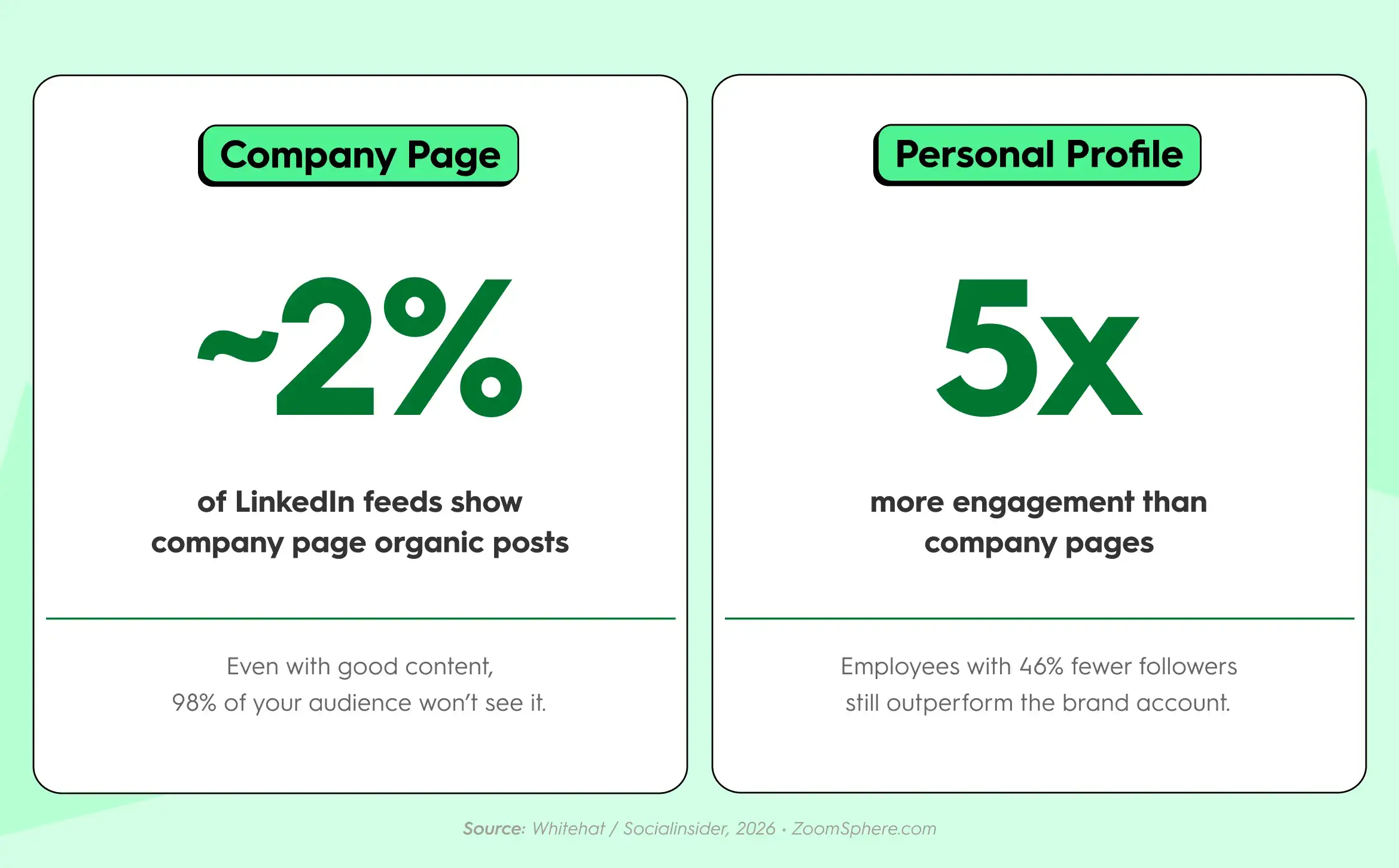
This is a structural channel problem, not a content quality problem. A company page has no career history, no professional associations, no point of view the model can match against a reader's professional profile. LinkedIn's ranking system is designed to find the right professional knowledge for the right professional reader. A brand page posting "Excited to share our latest case study" provides nothing for the algorithm to work with.
The agency implication is direct. If a client's LinkedIn strategy runs primarily through their company page, that strategy runs on a channel that accounts for roughly 2% of what their target audience sees. More content on that channel does not fix this. Posting better content on that channel does not fix this. The reach strategy needs to run through people: the founder, the subject matter experts, the team members whose professional background aligns with what the company sells. The company page still earns its place for ads, recruitment, and brand credibility. It is no longer a reliable organic reach engine, and presenting it as one sets up a conversation with the client that will happen anyway when the numbers do not move.
Does LinkedIn Penalize AI-Generated Content?
LinkedIn does not penalize AI-generated content. It deprioritizes content that holds no one's attention, and AI-generated posts without a specific professional insight at the center consistently fail on every behavioral signal that now determines reach.
The content industry has a word for this category: slop. Technically coherent, grammatically clean, professionally empty. The kind of post where every sentence is true of any company in any industry at any moment. Slop fails the depth score not because of how it was produced but because readers scroll past it in under three seconds. There is nothing to stop on, nothing specific enough to remember, nothing worth saving for later. The algorithm reads the resulting behavioral pattern, near-zero dwell time, no saves, generic or absent comments, and reduces distribution. The post reaches fewer people, generates even less engagement, and gets pushed further down. The client sees the numbers and asks what changed.
Here is what the difference looks like in practice.
A post generated by passing a client brief to an AI tool without any additional context:
"In today's competitive landscape, authentic content is more important than ever. Brands that invest in thought leadership are seeing real results. If you want to succeed on LinkedIn in 2026, focus on sharing genuine expertise, engaging with your community, and posting consistently. The algorithm rewards value."
No specific context. No data. No professional point of view that belongs to a person with an actual job and real experience. Nothing the reader has not seen in exactly this structure before. Dwell time: roughly three seconds. This is slop. The depth score registers nothing worth distributing.
A post where AI drafted and refined, but the central observation came from the client's actual work:
"We onboarded a client last month who had been posting three times a week for two years. Strong copy, consistent schedule, flatlined reach. The first thing we changed was not the format or the cadence. We asked what the founder knew about their industry that nobody in their space had said out loud yet. That became the first post. The numbers moved. Same account. Same schedule. Different raw material."
This is illustrative and contains no fabricated engagement figures. What makes it work is professional context, a specific observation about what changed, and a conclusion the reader can apply. It creates dwell time because it says something recognizable from real work that does not exist in that form anywhere else.
The brief for a strong LinkedIn post in 2026 is not "be authentic." It is: find one thing the client specifically knows from direct professional experience that is not available anywhere else in exactly this form. Build the post around that. AI earns its place in the process when it works with that raw material. It produces slop when it substitutes for it.
Why Is Your LinkedIn Reach Dropping? And How to Find the Actual Cause
Before changing your content strategy, the more useful question is which of three distinct problems is actually driving the decline, because each has a different cause and a different fix.
- If reach has dropped uniformly across all posts regardless of format, topic, or effort, and the pattern holds across all client accounts, the most likely variable is the company page structural disadvantage. The approximately 2% feed visibility applies regardless of content quality. Improving the content does not solve a channel architecture problem. The fix is redistributing the LinkedIn strategy toward individual profiles: founder content, employee advocacy, and subject matter expert voices, with the company page as a secondary amplification surface.
- If reach is inconsistent, with some posts performing and others not without an obvious format or timing pattern, the more likely variable is content depth. Posts with specific professional context and experience-based observations are surviving the depth evaluation. Posts with generic framing are not. The fix is a content brief process that captures one experience-based insight per post before any writing starts.
- If reach declined sharply in a window around March to April 2026 and has not recovered, the timing aligns directly with LinkedIn's March 2026 feed update. Tactics that reliably moved numbers in 2024, including engagement optimization, hashtag stacking, and peak-hour posting, provide minimal lift under the new system. The recovery path is topic consistency and content depth, not tactical refinement of the old approach.
Most agencies facing client reach declines in 2026 are dealing with some combination of all three. This is why changing the format or adjusting the posting schedule produces no improvement: each fix addresses the wrong variable.
How to Fix Your Agency's LinkedIn AI Workflow
The fix is not to stop using AI. The fix is to use it at the right steps.
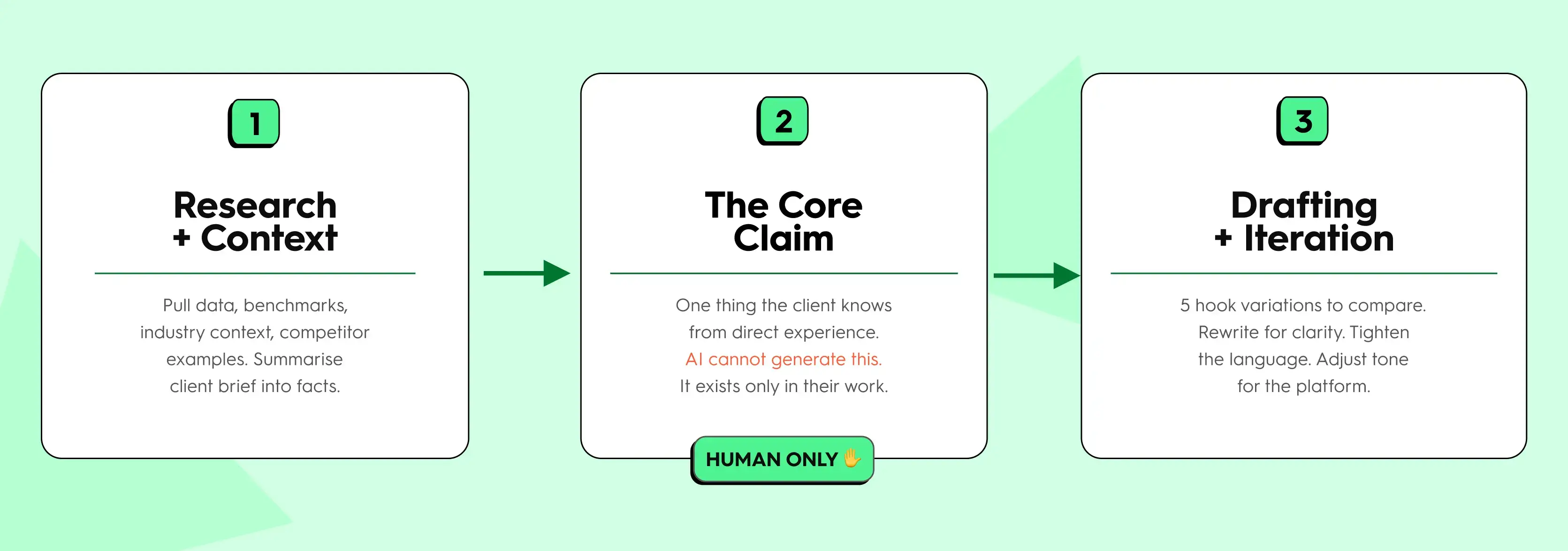
Most agency AI workflows for LinkedIn look like this: receive the client brief, pass it to an AI tool, receive a draft, lightly edit, schedule. This is fast. It produces slop. Not because the tool is bad at writing, but because the brief contains no information that only the client could provide. Without raw material that exists only in the professional experience of the person or team posting, the output is always a version of content that already exists everywhere.
The workflow that produces content LinkedIn's algorithm will distribute starts differently. Before any writing happens, the brief captures one observation that could only come from the client: a specific result from a recent project, a decision made and the reasoning behind it, a pattern the team has noticed across months of real work that they have not said publicly. Something that is not in any training data because it happened in a client meeting last Thursday.
From that raw material, AI has a clear and useful role. Research supporting data points that strengthen the claim. Generate five different hook variations to compare. Rewrite a clunky draft sentence without losing the original observation. These are tasks where AI improves work. Generating the original observation is not one of them.
For agencies, this means the brief is the most valuable deliverable in the workflow, not the post. Thirty minutes extracting the right insight from a client call is worth more to the algorithm, and to the client relationship, than sixty minutes polishing a draft that started from nothing.
Does Scheduling LinkedIn Posts Affect Organic Reach?
No, scheduling LinkedIn posts doesn't affect your organic reach. LinkedIn's ranking system evaluates content quality and post-publication engagement behavior, not the publishing method. LinkedIn has not introduced any mechanism that penalizes posts sent through third-party scheduling tools, and the March 2026 feed update does not change this.
The confusion is understandable. Reach declined for many accounts in the same period LinkedIn updated its feed, and some teams noticed the correlation while using schedulers. The causal variable is the content evaluation model change, not the tool used to publish. A post with strong depth signals scheduled a week in advance will outperform a post with weak depth signals published manually in real time.
For agencies managing multiple client LinkedIn accounts, the scheduling workflow does not disadvantage the content. The depth score is earned by what the post contains, not how it reaches the platform.
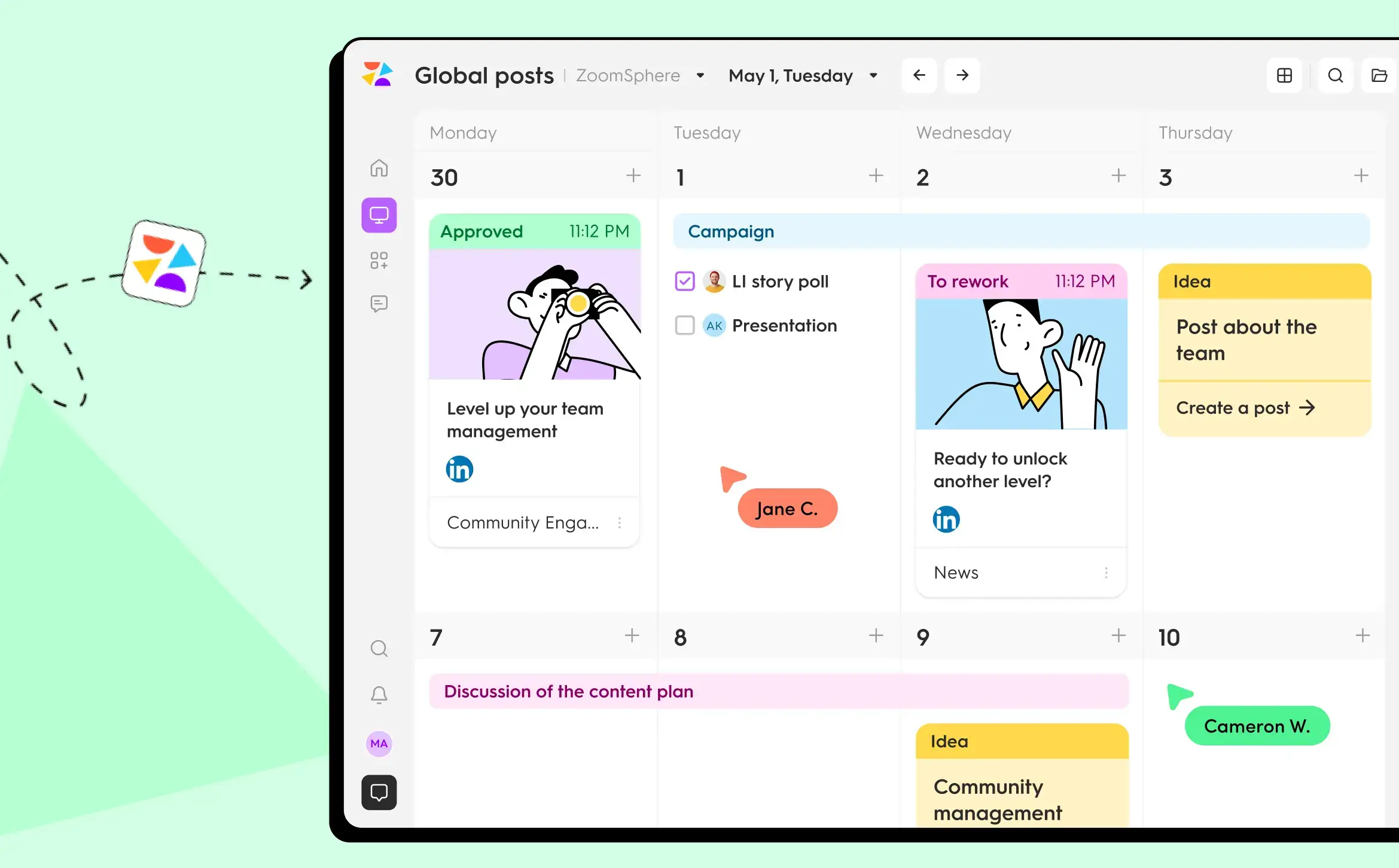
If managing LinkedIn across multiple clients currently means navigating separate logins, email approval chains, and performance data across spreadsheets, ZoomSphere's Scheduler brings all of it into one workflow. The raw material still has to come from the client. Everything that happens with it after that is already there.
{{cta-component}}
Frequently Asked Questions
What changed in LinkedIn's feed algorithm in 2026?
In March 2026, LinkedIn's engineering lead Hristo Danchev announced in a LinkedIn Engineering Blog post that the platform was replacing its fragmented architecture of specialized ranking models with a unified LLM-powered retrieval and ranking system. Search Engine Land confirmed the shift to LLM-powered ranking and retrieval. The new system evaluates posts alongside the author's professional profile and the reader's interaction history to predict relevance for a specific person, rather than scoring a list of separate engagement signals. LinkedIn's previous system was gameable by stacking behavioral signals; the new system evaluates meaning and professional relevance.
Does LinkedIn penalize AI-generated content?
Not directly. LinkedIn's algorithm does not classify posts as AI-generated and reduce their reach. What it measures is behavioral engagement: how long someone reads a post, whether they save it, and whether it generates substantive professional discussion. AI-generated content without specific professional context consistently scores low on all three signals because it lacks the author-specific insight and concrete experience that create dwell time. The suppression comes from reader behavior, not text detection.
Why did LinkedIn company page reach drop in 2026?
Company page organic posts now represent approximately 2% of what appears in LinkedIn users' feeds, according to Whitehat's 2026 analysis of Socialinsider platform data. Personal profiles generate five times more engagement than company pages. This is a structural algorithm issue: LinkedIn's ranking system is built to surface individual professional voices, not brand broadcasts. Improving the content on a company page does not close this structural gap.
How do I recover LinkedIn organic reach in 2026?
The recovery path depends on which of three problems is causing the decline. If reach has dropped uniformly across all company page content, the fix is structural: move thought leadership to individual profiles. If reach is inconsistent across posts, the fix is a content brief process that captures one experience-based insight per post before any AI drafting begins. If reach dropped sharply around March to April 2026, the tactics that worked in 2024, such as engagement optimization and hashtag strategies, no longer produce the same results. Sustained recovery requires topic consistency, post-level specificity, and patience as the algorithm builds a topic association for the account.
Are LinkedIn engagement pods still effective in 2026?
No. Coordinated engagement groups are recognized as a behavioral pattern by LinkedIn's current system. Because it reads comment language, generic pod comments are identifiable as a coordinated pattern and do not produce genuine distribution gains. Whitehat's April 2026 B2B algorithm guide cites research placing LinkedIn's pod detection accuracy at 97%.
Does LinkedIn penalize posts with external links in 2026?
Platform analyses are contradictory on this specific point. Dataslayer's April 2026 analysis shows posts with external links receiving approximately 60% less reach than posts without them. Whitehat's April 2026 guide cites separate research suggesting external links now see a modest positive effect. LinkedIn has not published definitive guidance on link treatment under the current system. The more reliable variable to optimize is content depth rather than link placement.
Does using a scheduling tool reduce LinkedIn organic reach?
No. LinkedIn's ranking system evaluates content quality and engagement signals, not publishing method. Scheduling posts through third-party tools does not affect reach. This was true under the previous system and remains true under the current one.
What should agencies change about their LinkedIn AI workflow?
Use AI for research, for generating and comparing hook options, and for rewriting drafts after the core professional insight already exists. Do not use AI to generate the post's central claim. The claim must come from direct professional experience: a specific result, a pattern observed across real client work, a decision and its reasoning. That raw material cannot be produced by AI. The writing around it can be.








Heading 1
Heading 2
Heading 3
Heading 4
Heading 5
Heading 6
Lorem ipsum dolor sit amet, consectetur adipiscing elit, sed do eiusmod tempor incididunt ut labore et dolore magna aliqua. Ut enim ad minim veniam, quis nostrud exercitation ullamco laboris nisi ut aliquip ex ea commodo consequat. Duis aute irure dolor in reprehenderit in voluptate velit esse cillum dolore eu fugiat nulla pariatur.
Block quote
Ordered list

- Item 1
- Item 2
- Item 3
Unordered list
- Item A
- Item B
- Item C
Bold text
Emphasis
Superscript
Subscript


Recommended for you
.webp)
%20(1).webp)
.webp)