


ZoomSphere vs. Metricool: Which Tool Is Right for Your Agency?

Whether you're currently using Metricool and starting to feel the friction, or evaluating it as a Metricool alternative for the first time, the question is the same: does this tool solve the actual problem your agency has right now?
What Is the Core Difference Between ZoomSphere and Metricool?
Metricool is a social media management tool built around analytics. Its core value is data:
- best-time-to-post heatmaps
- competitor benchmarking across up to 100 profiles
- ad campaign reporting across Meta and Google
- a Looker Studio connector
If the question clients pay you to answer is "what's working and what isn't," Metricool was built for that answer.
ZoomSphere is a social media management tool built around workflow. Its core value is process:
- structured sequential approval stages
- dedicated client workspaces separated by default
- color-coded status tracking so every team member sees exactly where a post stands
- collaboration layer for teams where multiple people touch every piece of content before it goes live
If the question your team asks every Monday is "where is this post in the approval process and who still needs to sign off," ZoomSphere was built for that answer.
Both tools schedule content. Both support major social platforms. The difference is structural: Metricool is optimized for what you learn after content publishes; ZoomSphere is optimized for the process that happens before it does.
{{form-component}}
ZoomSphere vs. Metricool: Full Feature Comparison
How Do ZoomSphere and Metricool Handle Content Approvals?
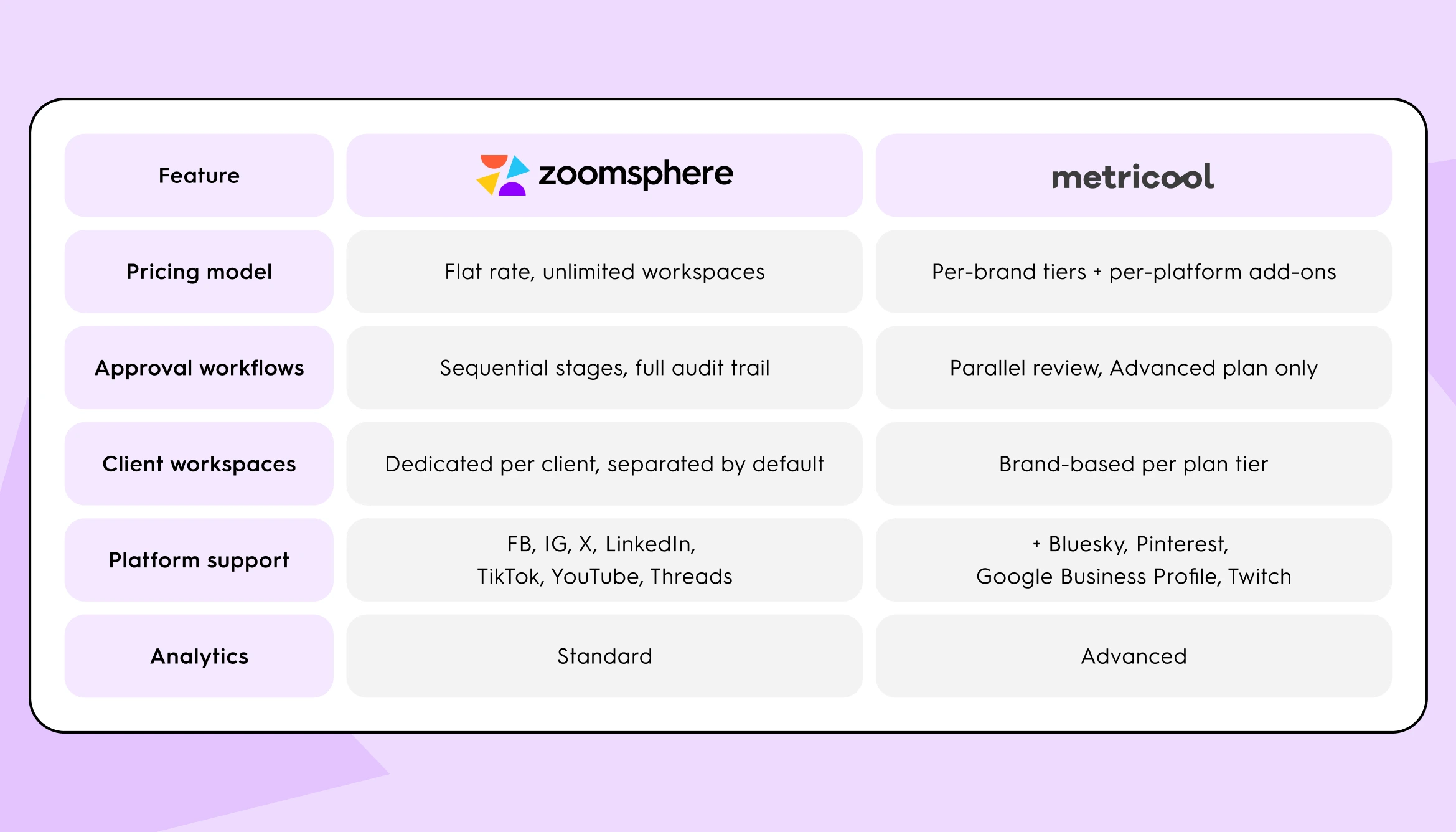
Metricool's approval system (Advanced and Custom plans) supports multiple reviewers assigned simultaneously. You can configure who must approve: no reviewer, at least one reviewer, or all reviewers; rejection by any single reviewer blocks publication regardless of who else has approved. This is a genuinely functional system for teams where all stakeholders can review content in parallel.
What it does not support is a sequential multi-stage workflow: content must clear Stage 1 (internal review) before it becomes visible to Stage 2 (account manager), before reaching Stage 3 (client sign-off). All assigned reviewers receive the post at the same time, in one round. For teams where the order of sign-off matters: where legal must approve before the client sees it, or where a senior editor must sign off before the post moves to a client, the absence of sequential stages is a meaningful constraint.
One specific gap is documented in Metricool's own notification article: approved posts generate no notification. When a post is sent for review, reviewers with Metricool accounts are notified automatically via My Tasks; the post creator can also enable an email notification per request. Reviewers added via external email always receive an email. When a post is rejected, the creator receives an automatic email (this cannot be disabled). But when a post is approved, no notification is sent to anyone. The creator must check the Planner or My Tasks manually to confirm that approval has been completed.
ZoomSphere's sequential approval workflow moves content through defined stages in order. Each stage is assigned to a specific person or role, every action is logged with a full audit trail, and email notifications can be configured per status so the right person is alerted when content reaches their stage automatically.
How Do ZoomSphere and Metricool Compare on Per-Platform Pricing?
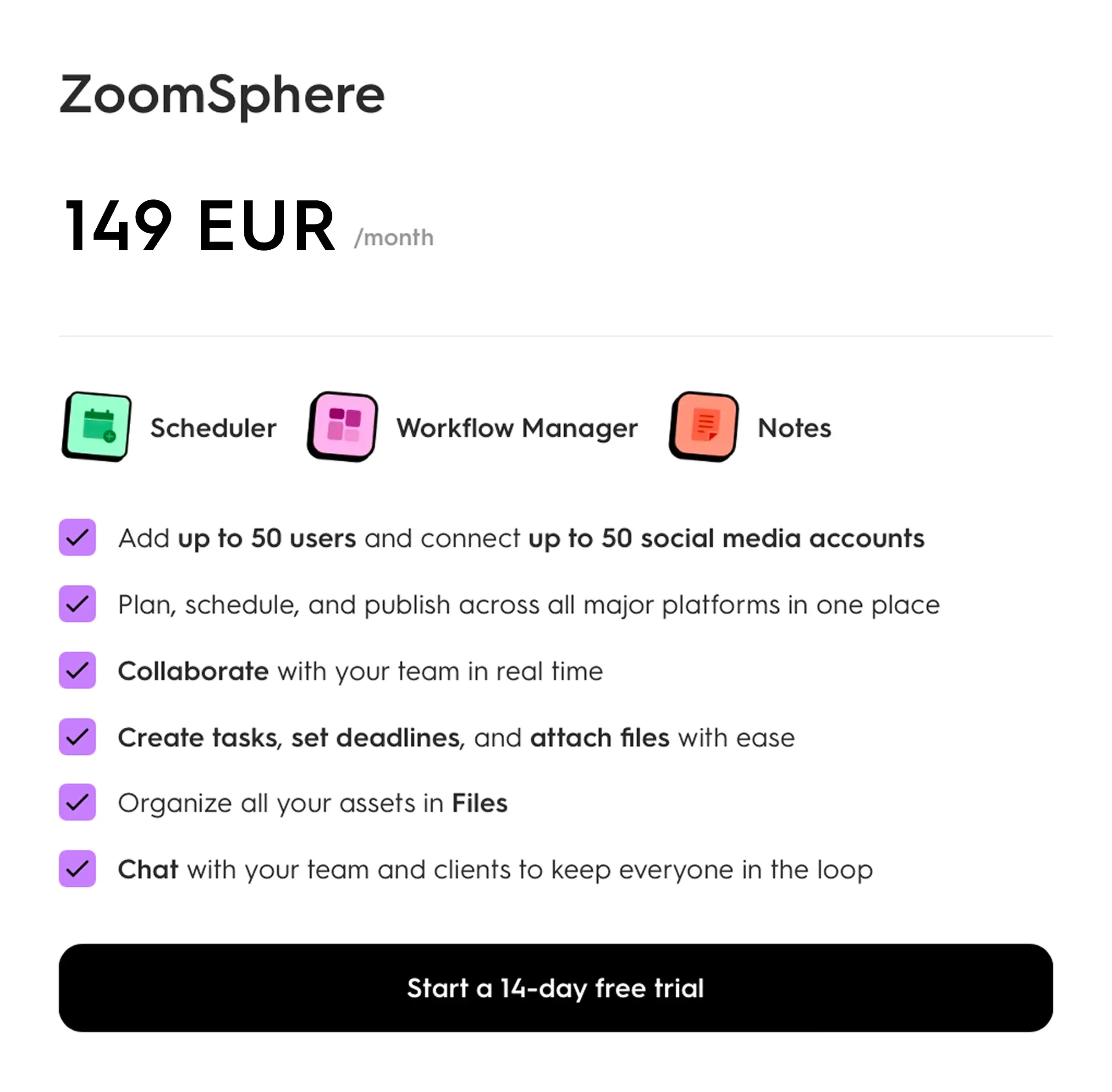
ZoomSphere's flat-rate plan includes all supported platforms (Facebook, Instagram, X (Twitter), LinkedIn, TikTok, YouTube, and Threads) within the 50-account limit, with no per-platform add-on fees. If you connect 20 LinkedIn accounts and 20 X accounts across your client portfolio, the cost is the same as connecting 40 Instagram accounts.

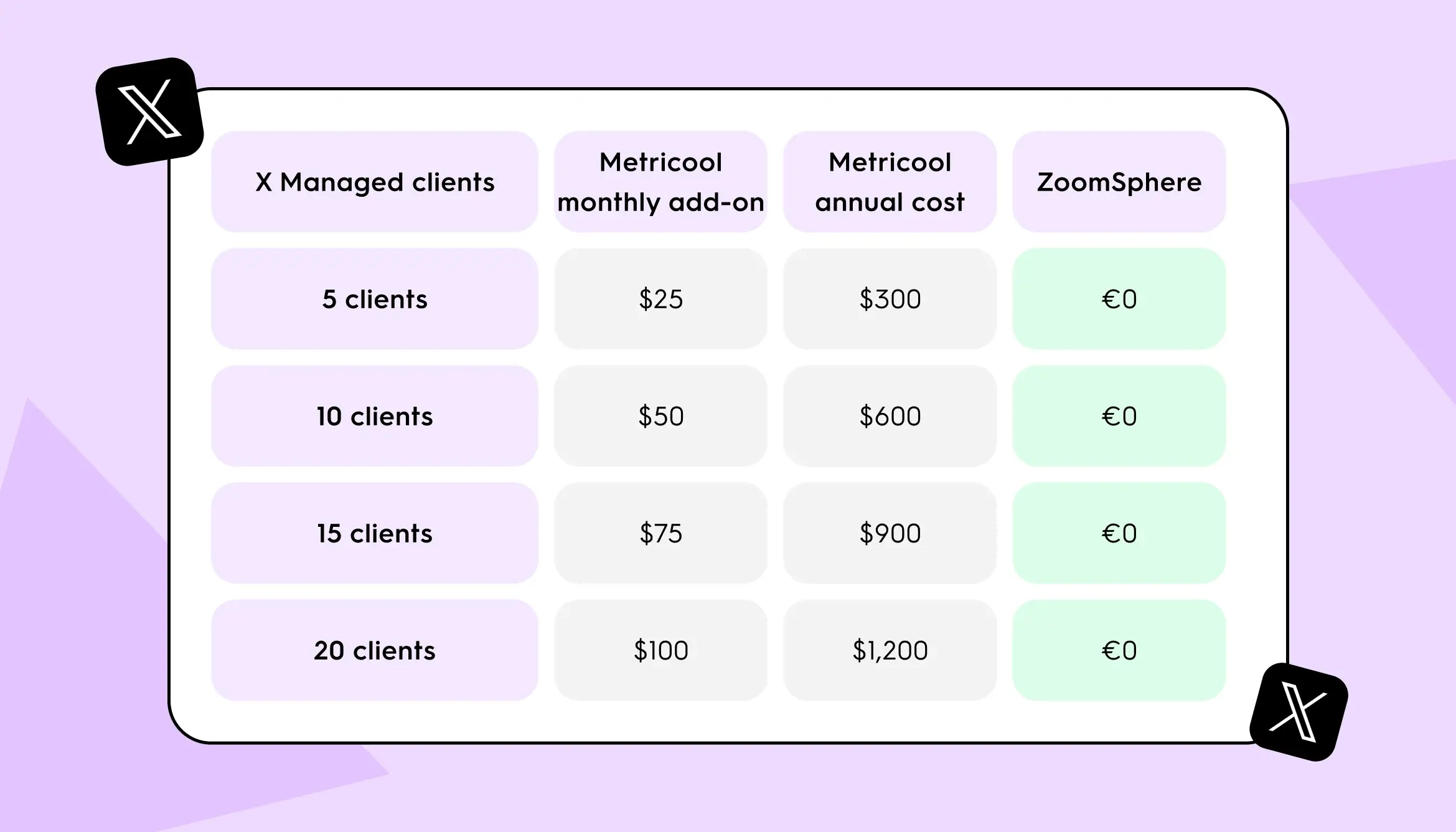
Metricool's pricing structure differs. LinkedIn is included from the Starter plan (from €16/month annual, up to 10 brands). However, Twitter/X is a paid add-on: +$5/month per connected X account, billed monthly with no annual discount on the add-on. For agencies managing X accounts across multiple clients, this add-on cost compounds regardless of which base plan tier you're on. At 10 clients with active X management: $600/year in platform add-ons on top of the base subscription.
The practical decision point: if Twitter/X management is standard across most of your client portfolio, Metricool's total cost is higher than the base plan price suggests. If X is irrelevant to most of your clients, the add-on is not a factor.
How Do ZoomSphere and Metricool Compare on Analytics?
Metricool is the stronger analytics tool. Its reporting suite includes best-time-to-post heatmaps, competitor benchmarking across up to 100 profiles (available from the Starter plan), ad campaign reporting across Meta and Google, a Looker Studio connector for custom client dashboards (Advanced and Custom plans), and granular audience demographic insights per platform. If performance reporting is the primary client deliverable, ZoomSphere does not replicate this depth.
ZoomSphere provides standard cross-platform analytics: reach, engagement, and post performance per channel. Sufficient for internal content reporting. Not sufficient as a standalone analytics and strategy product.
Which Social Media Platforms Does Each Tool Support?
Both tools cover the major platforms: Facebook, Instagram, X (Twitter), LinkedIn, TikTok, YouTube, and Threads. The difference is in the edges: Metricool additionally supports Bluesky, Pinterest, Google Business Profile, and Twitch. ZoomSphere does not. For agencies with clients in retail, local business, or gaming where these platforms are standard deliverables, this is a hard constraint, not a feature trade-off.
When Is Metricool the Right Choice for Agencies?
Metricool is the stronger choice when analytics is your primary deliverable, your team has simple parallel approval needs, Twitter/X is not widespread across your portfolio, or your clients require platforms ZoomSphere doesn't support.
Your core deliverable is analytics and reporting.
Metricool's analytics depth is hard to match at its price point. The heatmap-based posting time recommendations, competitor benchmarking across up to 100 profiles (from Starter), and the Looker Studio connector give reporting-focused teams a toolkit ZoomSphere does not replicate. If clients pay you primarily for data-driven strategy, campaign performance analysis, and competitor insights, Metricool was built for that use case. ZoomSphere's analytics are standard, not specialized.
Your team is small and approval isn't a bottleneck yet.
Metricool's Advanced plan includes an approval system sufficient for small teams with simple parallel sign-off needs. If one person creates, one reviews, and the client approves via a shared link, all in a single review round, a sequential multi-stage workflow system solves a problem you don't yet have. At one to three people with a simple review chain, Metricool Advanced at €54/month (monthly), or €43/month on annual billing, covers the basics without paying for infrastructure you won't use.
Twitter/X is not a standard channel for most of your clients.
Metricool's per-account add-on cost for X is irrelevant if X management is not part of your standard service package. Metricool charges $5/month per connected X account, with no annual discount on add-ons, but if you manage primarily B2C clients in food, retail, hospitality, or lifestyle where X is not a core deliverable, that cost simply doesn't apply. LinkedIn is included from the Starter plan, with no per-account add-on fee. Without X add-ons across most of your portfolio, Metricool's total cost at modest agency scale is meaningfully lower than ZoomSphere's flat rate.
Your clients need Pinterest, Google Business Profile, or Twitch.
Metricool supports these platforms natively. ZoomSphere supports Facebook, Instagram, X, LinkedIn, TikTok, YouTube, and Threads. If your client mix relies on Pinterest, Google Business Profile, or Twitch, this is a hard constraint that ends the comparison.
How Do You Know When to Switch from Metricool to ZoomSphere?
These aren't opinions. They're operational signals that the tool's architecture is creating friction rather than removing it.
Sign 1: Approval now happens in more than two places at once.
When the approval process for a single piece of content leaks across multiple channels (Metricool for drafting, email for feedback, WhatsApp for client sign-off, Slack for internal notes), the tool is no longer functioning as your workflow hub. That's the signal. Metricool's approval system (Advanced and Custom plans) supports assigning multiple reviewers simultaneously, but it does not support sequential stages. Where a brand manager, a legal reviewer, and a regional director each need to sign off in order (not simultaneously), Metricool's parallel review model requires a workaround.
One gap documented in Metricool's own notification article is relevant here: when a post is approved, Metricool generates no notification. Reviewers are notified automatically via My Tasks when a post arrives for review, and the creator receives an automatic email when a post is rejected. But when a post is approved, no one is alerted. The creator must check the Planner or My Tasks manually to confirm that approval has been completed. At team scale, when multiple posts are in review simultaneously, this manual check-in becomes a recurring overhead.
Sign 2: Adding a new client forces a pricing tier jump.
Every time Metricool's brand-count ceiling is hit, your software cost increases by a fixed amount, regardless of how much revenue the new client brings in. Metricool's Advanced plan covers 15 brands at €54/month (monthly) or €43/month (annual); the next tier covers 25 brands at €87/month (monthly) or €69/month (annual). Adding a 16th client forces a ~€26/month increase on annual billing, or ~€312/year from a single account. This tier structure means software cost scales non-linearly with agency growth. At 15 or more clients, the pricing model starts working against an agency that is actively trying to grow.
Sign 3: Twitter/X add-ons are compounding as your client roster grows.
Twitter/X is not included in any Metricool plan. It costs $5/month per connected X account, billed monthly with no annual discount. If you manage X for 10 clients: $50/month extra, or $600/year. For 15 clients: $75/month extra. For 20 clients: $100/month extra. This cost does not exist in ZoomSphere's pricing model: all supported platforms, including X, are included in the flat rate. For agencies where X management is standard across a significant portion of the portfolio, Metricool's true cost diverges from the headline price.
If two of the three signs apply to your agency right now, the section below and the pricing scenarios that follow are written for you. If only one applies, or none, the Metricool section above is the more relevant read.
When Is ZoomSphere the Right Choice for Agencies?
ZoomSphere is the stronger choice when workflow overhead (not analytics gaps) is the primary constraint on your agency's efficiency. Specifically, it fits when team size, client volume, sequential approval requirements, or platform coverage within the flat rate make Metricool's architecture work against you.
Your team has grown past the point where informal approval works.
At five or more people with defined roles, content stops moving cleanly without a system. A content creator, an internal reviewer, an account manager, and a client-facing approver each touching the same post means four opportunities for something to stall or get lost, and for many agencies, the order of those approvals matters. ZoomSphere's sequential approval workflow moves content through defined stages in order: each stage is assigned to a specific person, access to the next stage requires completing the previous one, and every action is logged with a full audit trail. ZoomSphere's Scheduler allows email notifications to be configured per status; once configured, the relevant person is alerted when content reaches their stage, rather than having to check manually.
What that looks like at scale: Positive Adamsky, one of the largest social media agencies in Central Europe, manages 330+ social channels across 100+ brands with 213 users on ZoomSphere. In January 2025, the team published 2,207 posts: 92% of them fully auto-published after the approval process completed. A team member put it directly: "The color-coded statuses in Scheduler give us complete peace of mind. The moment all of our created posts turn green, we know everything is approved, and we can confidently move on to the next project."
Your platform mix includes Twitter/X across most of your portfolio.
ZoomSphere's flat-rate plan includes all supported platforms (Facebook, Instagram, X, LinkedIn, TikTok, YouTube, and Threads) with no per-platform fees. Metricool charges $5/month per connected X account, billed monthly with no annual discount on add-ons. At 10 clients with active X management: $600/year in add-ons on top of the base subscription. At 15 clients: $900/year. At 20 clients: $1,200/year. This cost does not exist in ZoomSphere's pricing model. For agencies where X is a standard deliverable across most of the client portfolio, ZoomSphere's total cost over time is lower despite the higher base price, once X add-ons are included.
Your client count is approaching or has passed 15 on a Metricool plan.
For agencies within ZoomSphere's standard plan limit of 50 social accounts, the flat rate of €149/month (annual) does not increase as you add clients. When you sign a new client within that limit, your software cost stays the same. This matters most in the 12-to-45 client range where Metricool's per-brand tier structure would otherwise trigger multiple cost jumps. For agencies managing more than roughly 25 clients with 2 channels each, account volume will likely exceed ZoomSphere's standard plan limit and require a custom pricing conversation.
Client workspace separation is a requirement, not a preference.
Clients need to see their own content, approve it, and leave feedback, without any visibility into other clients' work. ZoomSphere's workspace architecture makes this the default. Each client workspace is independently contained with its own permissions, channels, and access controls.
You're operating in the EU and care about where your data lives.
ZoomSphere is built and hosted in the Czech Republic. Metricool is also GDPR-compliant following its 2024 acquisition by Belgian company team.blue, so the distinction is less sharp than it was two years ago. For agencies with specific data residency requirements in client contracts, ZoomSphere's EU infrastructure is a verifiable, documentable fact.
How Much Does Metricool vs. ZoomSphere Cost for a Growing Agency?
The entry price of any social media management tool tells you almost nothing about what a growing agency actually pays. Below are three modeled scenarios for a 20-client agency.
Methodology: All figures use public pricing from both platforms as of May 2026. Metricool annual billing reflects the annual subscription rate shown on Metricool's pricing page in EUR; no annual discount applies to X add-ons. ZoomSphere annual billing: €149/month, billed as €1,790/year. Both tools offer EUR billing for their base plans. Metricool's Twitter/X add-on is billed in USD at $5/month per connected account, regardless of base plan currency. Scenario totals below show Metricool base costs in EUR and X add-on costs in USD, as they appear on Metricool's pricing page. The 50-account ceiling on ZoomSphere's standard plan is a real constraint reflected honestly in Scenarios B and C.
Scenario A: 20 clients, X not a core channel (2 channels per client: Facebook + Instagram = 40 total accounts)
Relevant for: B2C agencies in retail, food, lifestyle where X management is not part of the standard package.
- Metricool Advanced 25 brands (annual): €69/month. No X add-ons. Annual total: ~€828.
- ZoomSphere flat rate (annual): €149/month. 40 accounts within the 50-account limit. Annual total: €1,790.
Metricool is the more cost-effective choice in this scenario, and the analytics depth is stronger. For agencies at this profile, switching to ZoomSphere means paying roughly twice as much for workflow infrastructure they don't need, and giving up analytics capabilities their clients pay for.
Scenario B: 20 clients, X standard for all clients (3 channels per client: Facebook + Instagram + X = 60 total accounts)
Relevant for: Agencies managing X as a standard deliverable: news, sports, entertainment, tech, or political clients.
- Metricool Advanced 25 brands (annual): €69/month base + X add-on for 20 accounts ($100/month, billed in USD). Annual total: ~€828 base + $1,200 in X add-ons.
- ZoomSphere: 60 accounts exceeds the standard 50-account flat-rate plan. Custom pricing applies; the €149/month figure does not apply at this volume. A direct quote from ZoomSphere's team is required before a meaningful cost comparison is possible.
Metricool's cost is fully calculable at this profile; ZoomSphere's requires a quote. The X add-on has no annual discount, so $1,200/year is a fixed per-account cost regardless of tier. If ZoomSphere's custom pricing comes in below the combined Metricool total, the decision rests entirely on workflow and analytics fit.
Scenario C: 20 clients, X for 10 clients, 2 channels for remaining 10 (10 clients × 3 channels + 10 clients × 2 channels = 50 total accounts)
Relevant for: Agencies with a mixed client base: some in sectors where X matters, others where it doesn't.
- Metricool Advanced 25 brands (annual): €69/month base + X add-on for 10 accounts ($50/month, billed in USD). Annual total: ~€828 base + $600 in X add-ons.
- ZoomSphere flat rate (annual): €149/month. 50 accounts exactly at the standard plan limit. Annual total: €1,790.
In this scenario, Metricool is the lower-cost option. At €828 base + $600 in X add-ons (approximately €1,370 combined at current exchange rates), Metricool comes in below ZoomSphere's €1,790. At this level of cost difference, the decision should be based on workflow fit, not price. The right question: how much time per week does your team spend tracking approval status outside the tool? If that number is climbing, the tool's cost is not your real constraint.
Which Type of Agency Should Use ZoomSphere vs. Metricool?
The right social media management tool depends on agency size, client mix, and where operational friction actually lives. Here are three concrete profiles.
The reporting agency: 6 clients, 2 people, analytics is the product.
This agency's core deliverable is performance data: monthly dashboards showing reach, engagement, competitor benchmarking, and ad performance. The team is small enough that approval is one email and one reply, all in a single round. Most clients are in food and retail; X and Pinterest aren't part of the standard package.
At this profile, Metricool is the right tool. The analytics depth matches the deliverable. The team size matches the parallel approval model. Switching to ZoomSphere would mean paying €149/month for sequential workflow infrastructure that serves no current function, and giving up the competitor benchmarking and Looker Studio integration that clients pay for.
The multi-client workflow agency: 18 clients, 6 people, sequential approvals required.
This agency runs on volume. Content moves through an internal review, then a senior review, then a client approval, then a legal check at two of the eighteen clients. The order of these stages matters: the legal team must not see unapproved copy. The team spends real time every week tracking who approved what and chasing status updates across email and Slack. X management is standard for twelve of the eighteen clients.
At this profile, ZoomSphere is the stronger fit. The sequential approval architecture, the client workspace separation, and the flat-rate pricing without X add-ons all directly address the documented operational bottlenecks. The analytics gap is real. If data-driven reporting is also a core deliverable at this agency, that gap will matter. For agencies where workflow is the primary constraint and analytics is secondary, the fit is strong.
The agency at the inflection point: 13 clients, 4 people, growing fast.
This agency is using Metricool Advanced 15 brands and has two slots left before the pricing tier jumps. X matters for seven clients. The approval process is mostly working, but the team is handling sequential approval steps informally across email. Someone on the team is spending meaningful time each week on approval-related messages that happen outside the tool.
At this profile, the honest answer is: run a real trial before deciding. The annual cost difference at this scale is not the deciding factor. The question to answer in the trial is specific: does ZoomSphere's sequential approval workflow reduce the overhead of chasing approvals to a fraction of what it currently is? If yes, the switch pays for itself quickly. If the friction comes from client relationship complexity rather than tool limitations, switching platforms won't fix it.
Frequently Asked Questions
How many client brands can Metricool handle?
Metricool's Advanced plan covers up to 15 brands at €43/month (annual) or €54/month (monthly); up to 25 brands at €69/month (annual) or €87/month (monthly); up to 50 brands at €130/month (annual) or €172/month (monthly). Beyond 50 brands, pricing is custom. Each tier jump is a fixed cost increase regardless of how many clients within the tier you're currently using.
What are Metricool's main limitations for agencies managing multiple clients?
Three limitations come up most consistently in agency contexts: the absence of a sequential multi-stage approval workflow (Metricool supports parallel review by multiple reviewers, but not ordered stages); per-brand pricing that scales non-linearly with client growth; and Twitter/X as a paid add-on ($5/month per account) that compounds as the portfolio grows. A fourth limitation is documented in Metricool's own notification article: when a post is approved, no notification is generated; neither the creator nor any team member is alerted. Status must be checked manually. For agencies where these constraints are not active problems, Metricool's analytics and reporting capabilities are strong.
Does ZoomSphere have competitor benchmarking?
Basic analytics are available, but competitor benchmarking across multiple profiles is not a primary ZoomSphere feature. If competitor tracking at depth (up to 100 profiles, with historical data and heatmaps) is a core deliverable for your clients, Metricool holds a meaningful advantage here. This feature is available from Metricool's Starter plan
Can external clients access and approve content in both tools?
Yes, in both. Metricool's Advanced plan includes collaborator roles that allow clients to access and approve content within a specific brand without seeing other brands' data. ZoomSphere includes client workspace access within its flat-rate plan, with each client workspace separated by default.
How does ZoomSphere handle high-volume content operations?
ZoomSphere's sequential approval architecture is designed for high-volume, multi-client operations. Positive Adamsky, managing 330+ social channels across 100+ brands with 213 users, published 2,207 posts in January 2025 alone: 92% fully auto-published after completing the approval process. The platform's color-coded approval status system gives teams clarity at that scale: only posts marked "Approved" are auto-published, so a fully green Scheduler view means all content has cleared every configured sequential approval stage.
What platforms does ZoomSphere support?
ZoomSphere supports Facebook, Instagram, X (Twitter), LinkedIn, TikTok, YouTube, and Threads. It does not currently support Bluesky, Pinterest, Google Business Profile, or Twitch. If your clients require those platforms, Metricool is the right choice.
ZoomSphere or Metricool: How to Choose the Right Tool for Your Agency
Metricool is the right social media management tool if: your primary deliverable is analytics and reporting; your team has simple parallel approval needs without sequential stages; Twitter/X is not standard across most of your client portfolio; or your clients require Bluesky, Pinterest, Google Business Profile, or Twitch.
ZoomSphere is the right tool if: your team requires sequential multi-stage approvals where order matters; Twitter/X is standard across most of your portfolio and add-on costs are compounding; your client count is within the range where ZoomSphere's flat rate applies and Metricool's tier jumps are creating cost pressure; or the time your team spends tracking approval status outside the tool is measurable in hours per week.
If you recognize two of the three signs from the section above in your agency's current workflow, the ZoomSphere trial is worth one specific test: run a real client approval cycle through the tool, from brief to published post. That is enough to know whether the sequential approval architecture changes your team's week in a meaningful way.
{{cta-component}}










Recommended for you
%20(1).webp)
%20(1).webp)
%20(1)%20(1).webp)