


Why Your AI Captions Sound Like Everyone Else’s (And How to Actually Fix It)

Here's a thought experiment. Open your social media scheduler, ask the AI to write a caption for your latest post, and read it back out loud.
Does it sound like you?
Or does it sound like it could have been written for any brand, in any industry, on any platform, at any point in the last three years.
If you paused before answering, you're not alone. Somewhere between the promise of AI-powered content and the reality of actually hitting publish, something gets lost. The voice. The personality. The tiny details that make a brand feel like it was made by actual humans with actual opinions, rather than assembled from the same template everyone else is using.
The frustrating part is that this isn't an AI problem. AI is genuinely capable of writing content that sounds like your brand. It just doesn't know what your brand sounds like unless you tell it. Specifically.
What Is Brand Voice, and Why Does It Matter for Social Media?
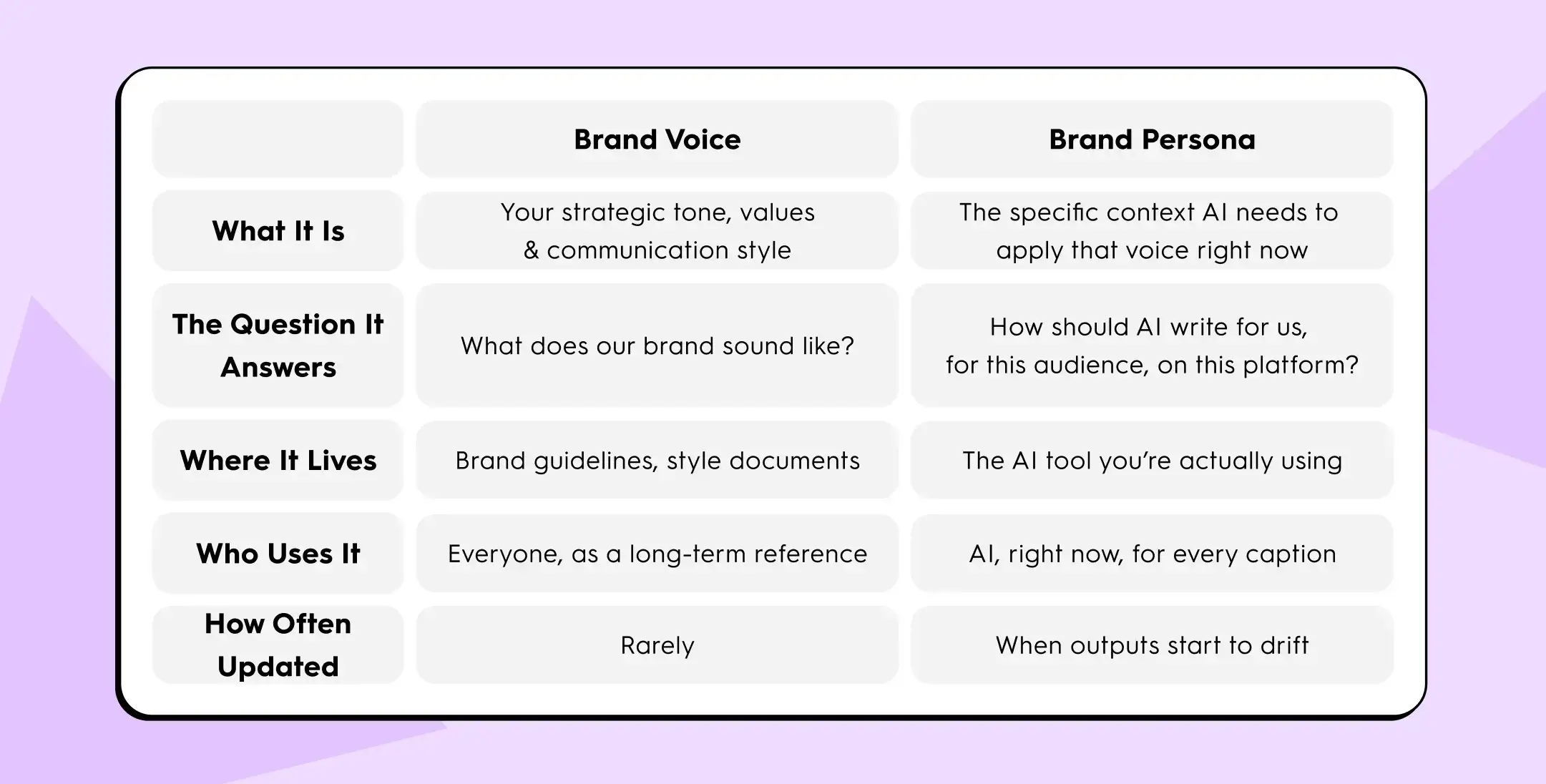
Brand voice is your brand's consistent tone, communication style, and personality. The way your brand sounds across every piece of content, regardless of platform or format.
It's the difference between a brand that feels distinctive and one that blends into the feed. It's why you can read a caption with no logo and still know which brand wrote it. And it's one of the few things in marketing that genuinely compounds. A brand that sounds like itself consistently over months and years builds recognition that has real commercial value.
For social media specifically, brand voice matters more than in almost any other channel. Social moves fast. Your audience sees your content in a scroll, alongside dozens of other brands competing for the same half-second of attention. Either the tone feels familiar and right, and they stop, or it doesn't, and they just keep going.
Social is also high-volume. What does it mean? Means you're not publishing one piece of content a week. Instead you're publishing multiple times a week, across multiple platforms, often with multiple people involved in creating it. Maintaining a consistent voice at that volume, without systems to support it, is genuinely hard.
What Is a Brand Persona? And Is It the Same as Brand Voice?
- Brand voice is your what. The strategic layer. The consistent tone and values that make your brand recognizable. It's described in adjectives and principles: direct, warm, irreverent, human. It lives in your brand guidelines and is relatively stable.
- Brand persona is your who and for whom. The operational layer. The specific context that tells AI how to apply that voice in a given moment. Who's reading this? What register is right? What does your audience already know? What do you absolutely never say?
Here's a way to think about the difference: brand voice is what you'd say at a brand strategy workshop. Brand persona is what you'd put in a brief before asking a contractor to write a week of captions.
Most brands have invested real effort in the first. They have tone-of-voice sections in their guidelines, adjective lists, do-and-don't examples. Those documents are genuinely useful for onboarding human writers who will absorb them over time.
But AI hasn't absorbed anything. It doesn't remember your brand from session to session. It doesn't know your guidelines exist. Every time you open a new AI session and type "write a caption," you're starting from zero. The AI defaults to the statistical average of everything it was ever trained on. That average sounds polished, upbeat, slightly vague, and ends with a question or a CTA. It sounds, in other words, exactly like the generic captions you've been trying to avoid.
Why Does AI Write Generic Captions?
AI language models are trained on enormous amounts of text from the internet. The "average" social media caption across all that training data is professionally neutral: positive, brand-safe, not too specific, broadly applicable to any company. Something like: "Exciting news! We're thrilled to share [product] is now available. Have you tried it yet? 👇"
No brand actually talks like that. And yet without additional context, that's what you get.

When you give AI a detailed prompt, you're pulling it away from that generic center toward something more specific. The more specific your input, the more distinctive the output, and vice versa.
The problem is that most people are inconsistent about how much context they give. On Monday morning when you have time, you write a proper brief. On Thursday afternoon with 14 posts due, you type "caption about our new feature" and accept whatever comes back. By the end of the week, your feed sounds like it has three different personalities.
This isn't a discipline problem, it's a systems problem. You shouldn't have to manually re-brief the AI on your brand voice every single session. That information should already be there.
The Real Cost of Inconsistent Brand Voice on Social Media
It's easy to treat this as a minor quality issue. Some captions are great, some are a bit off, overall fine. But inconsistent voice has compounding downstream effects.
Audience recognition erodes. Brand voice is one of the primary signals audiences use to recognize a brand without seeing the logo. A feed that sounds different every week gives the audience nothing to latch onto.
Trust takes a quiet hit. When content sounds generic or slightly off-brand, audiences feel it even if they can't articulate it. Over time, that low-grade sense of "something's off" erodes the relationship between brand and audience.
AI discoverability suffers. Answer engines, the AI layers people are increasingly using to discover products and get recommendations, favor content that is specific, consistent, and authoritative. Generic content blends into noise. It doesn't get cited, doesn't get referenced, and doesn't build the kind of recognizable voice that AI systems learn to associate with expertise in a category.
Team knowledge becomes fragile. When brand voice lives in individuals rather than systems, it walks out the door with every team change. Onboarding resets it. Turnover erases it.
What Does a Strong Brand Persona Actually Contain?
A brand persona written for AI use is different from a brand guidelines document written for human writers. Humans absorb nuance over time, but AI needs explicit, operational instructions it can apply right now.
Here's what actually moves the needle:
1. Tone in behavioral language, not adjectives
❌ "Friendly and professional" is not useful to an AI.
✅ "Write like a knowledgeable friend who gives you the straight answer without the preamble, warm but direct, no filler, no corporate speak" is.
The test: could a contractor follow this brief without a follow-up question?
2. An audience description with mindset, not demographics
❌ "B2B marketers aged 25-45."
✅ "Social media managers who are experienced enough to be skeptical of trends, short on time, and will immediately clock anything that sounds written to impress rather than to be useful."
3. An explicit exclusion list
This is the most underrated input in any AI brief. Telling the AI what you never say is often more useful than telling it what you do say, because exclusions prevent the default behaviors that make content feel generic.
✅ "Never use: game-changer, synergy, unlock your potential, thrilled to announce. Never start with 'Are you ready to?' No more than one emoji per caption."
4. Platform-specific notes
Not a separate persona per channel, just brief adjustments at the end. Two or three sentences per platform is enough.
✅ "LinkedIn: analytical, longer, ends with a question. Instagram: punchy, short sentences, emojis at the end only. Facebook: warm, practical, tip-style framing."
5. Your brand's actual point of view
Not your mission statement. Your real take. This is what produces content with an actual perspective instead of content that just describes features.
✅ "We think most marketing advice is noise. We'd rather say one true thing than ten useful-sounding things."
A complete brand persona for AI use is typically 200-400 words. Short enough that the AI can hold it in context, specific enough to meaningfully change the output.
What's the Difference Between a Brand Persona and a Prompt?
A prompt is a one-time instruction. A persona is a saved context that applies automatically to everything.
If brand voice lives in prompts, it's only as consistent as whoever wrote the most recent prompt. Three people writing prompts on three different days will brief the AI differently. The output reflects those differences. The feed accumulates small inconsistencies that, over time, add up to a brand that sounds a bit like itself but never quite commits.
If brand voice lives in a saved persona, one that's applied automatically every time someone opens the scheduler and hits "generate," consistency becomes structural rather than personal. It doesn't depend on who's on the account today or how much time they had to write a brief.
For agencies this is especially valuable. Each client workspace can have its own persona. The conservative financial services client doesn't accidentally start sounding like the edgy DTC startup client. The boundaries are built into the tool, not maintained by remembering which tab you're in.
How Does ZoomSphere Handle Brand Persona?
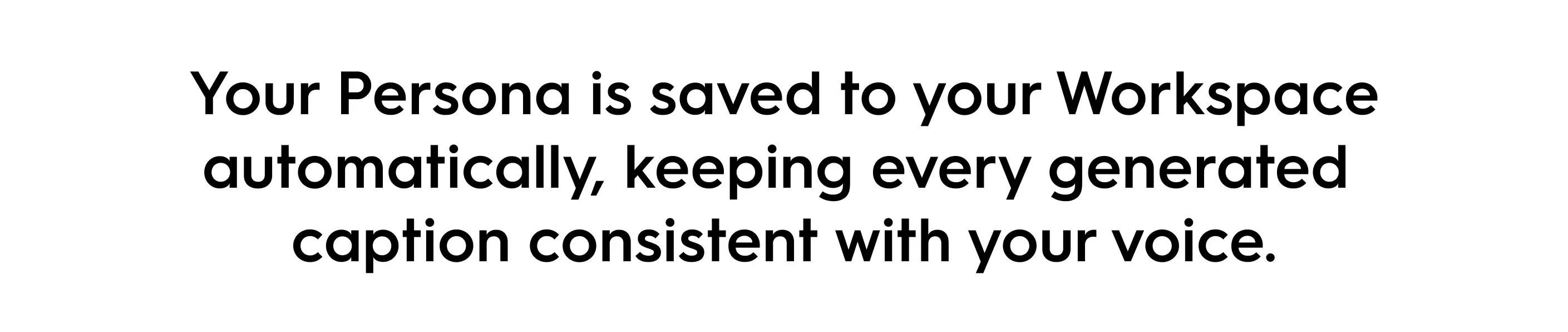
ZoomSphere's AI copywriter includes a Persona field built directly into the Scheduler. You write your brand persona once — tone, audience, what to say, what to avoid, platform context — and it's saved to your workspace automatically.
Every caption generated from that workspace uses that persona as its context. You're not re-briefing the AI at the start of every session. You're not hoping the person covering this week remembered to mention the lowercase thing. You set it once, and it applies consistently from that point forward.
The persona is saved per workspace, which means:
- Each client gets their own persona (for agencies)
- Multiple team members generate content with the same voice baseline
- New team members produce on-brand content from day one, without a lengthy onboarding process
- The brand voice doesn't walk out the door when someone leaves
It's worth being direct about what this solves and what it doesn't. A saved persona doesn't replace strategy or creative judgment. Content still needs thought, and the best captions still come from people who understand the brand deeply. What the persona does is raise the baseline quality of AI output so you're editing instead of rewriting, across the conditions that tend to produce the most off-brand content: busy weeks, team changes, Friday afternoons.
{{cta-component}}
Does Brand Persona Work the Same Way Across Platforms?
Not quite. The core persona stays consistent: the brand's fundamental tone, values, and exclusion list are the same whether you're writing for LinkedIn or Instagram. What changes is how that voice expresses itself on each platform.
- LinkedIn rewards substance: longer captions, analytical framing, a strong point of view.
- Instagram rewards brevity: short sentences, punchy opening lines, visual-led framing.
- Facebook sits somewhere in between, with a warmer, more practical register.
- TikTok and Reels captions are often secondary to the video itself, used to add context or a hook rather than carry the full message.
💡 The practical implication: include brief platform notes in your persona. Not a separate persona per platform, just a short addendum that covers the key adjustments. Three sentences per platform is usually enough.
What Happens to Consistency Without a Saved Persona?
Social media consistency, without structural systems, depends entirely on the discipline of every individual creating content, the quality of every manual prompt they write, and institutional memory that lives in people rather than tools.
In practice, that produces a predictable pattern. On a good week, same person, focused, enough time, the content is consistent and on-brand. On a normal week, it's mostly fine with a few captions that drift in tone as the week gets busier. On a bad week, multiple people, late approvals, 14 posts due Thursday, the feed sounds like it has three different personalities and nobody had time to catch it before publishing.
During team changes, holiday cover, or onboarding, consistency basically resets to zero.
A saved persona raises the floor significantly. The bad-week output becomes closer to the normal-week output. The holiday cover doesn't produce content that sounds nothing like the brand. And the new hire's first week of captions doesn't require a complete redo.
Brand Voice in 2026: Why This Matters More Than It Used To
A few things have changed that make this conversation more urgent.
- AI content volume has increased dramatically. More content is being produced faster, with more AI involvement at every stage. The brands that sound distinctive are the ones that have built systems to maintain that distinctiveness at scale.
- AI-mediated discovery is real and growing. People increasingly find products through AI assistants and answer engines rather than traditional search. Those systems favor content that is specific, consistent, and authoritative. Generic content doesn't get cited, surfaced, or recommended.
- Audiences are getting better at spotting AI-speak. The patterns of undirected AI output, the corporate positivity, the vague enthusiasm, the reflexive questions, are becoming recognizable. When audiences clock it, it reads as lazy. The brands that maintain a genuine, specific voice stand out more than they ever did precisely because so much content has drifted toward generic.
{{form-component}}
Wrap Up!
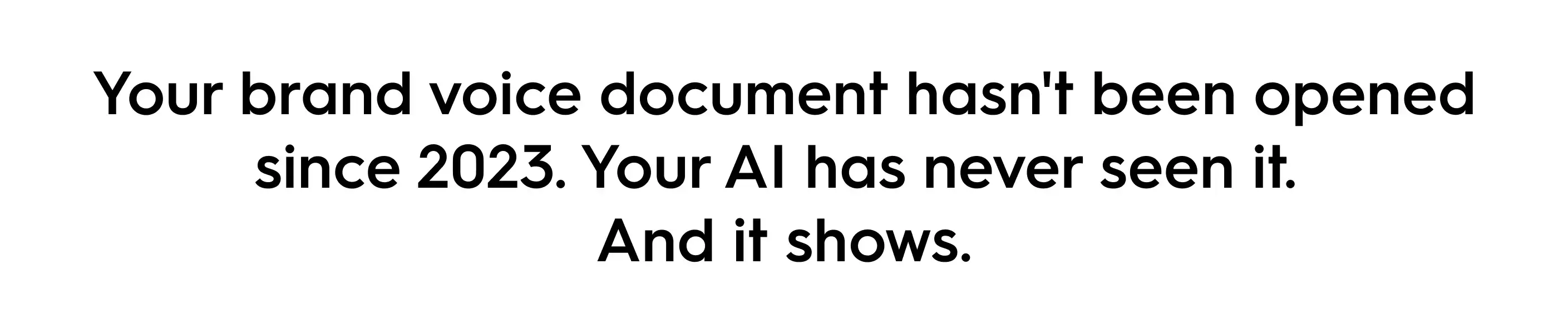
Brand voice doesn't live in a Google Doc that hasn't been opened since last year. It lives in the outputs. In the captions that actually get published, in the content that accumulates into a recognizable identity over months and years.
The gap between "brand voice document" and "brand voice in practice" has always existed. What's changed is that AI has made the volume problem solvable. You can produce more content than ever with less effort. But it's only actually useful if the content sounds like you.
Write the persona. Save it somewhere that applies it automatically. Stop re-briefing the AI on your brand voice every single session, hoping whoever's on the account today remembers all the details.
Your brand voice is either a system or an afterthought. One of those scales, the other doesn't.








Heading 1
Heading 2
Heading 3
Heading 4
Heading 5
Heading 6
Lorem ipsum dolor sit amet, consectetur adipiscing elit, sed do eiusmod tempor incididunt ut labore et dolore magna aliqua. Ut enim ad minim veniam, quis nostrud exercitation ullamco laboris nisi ut aliquip ex ea commodo consequat. Duis aute irure dolor in reprehenderit in voluptate velit esse cillum dolore eu fugiat nulla pariatur.
Block quote
Ordered list

- Item 1
- Item 2
- Item 3
Unordered list
- Item A
- Item B
- Item C
Bold text
Emphasis
Superscript
Subscript


Recommended for you
%20(1).webp)
%20(1).webp)
%20(1).webp)